
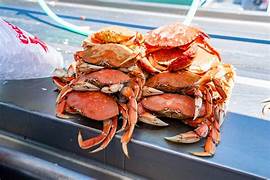
Tom Petty Seaside Christmas Crabbing
SPLASH!
A crab ring plunged from a bridge into a coastal river under overcast skies on the day before Christmas. Then another ring. Then another. The splashes sounded like reports from musket fire, but the three homeless men on the bridge who had tossed the rings didn’t hear that sound. All they heard was a Tom Petty and the Heartbreakers CD blasting “Refugee” out of a vintage boombox.
One man drank a can of malt liquor, one drank a can of hard cider, the other smoked a stub of a cigarette he’d just discovered on the sidewalk.
At one point, the three men started singing along to the song as their rings floated to the bottom of the channel and struck mud.
Listen, it don’t really matter to me, baby
You believe what you want to believe
You see, you don’t have to live like a refugee
(Don’t have to live like a refugee)
They couldn’t sing for shit, but who cared? They didn’t. They just loved Tom Petty and especially this song. Maybe it was because they were refugees from American life but not moving anywhere to a better place because they didn’t know the way. They didn’t know there was such a path. Had there ever been one for many Americans?
A few minutes later, a red and white two-tone Ford F-150 pickup truck from roughly the era “Refugee” was a hit, parked alongside the bridge.
The three men screamed, “Larry and Tommy Gun!” and began pantomiming firing a machine gun and making preposterous bullet noises.
Larry and his black mutt named Tommy Gun bounded out of the cab. Larry held up a Thermos of coffee and bag of bagels he’d toasted up in his kitchen and slathered with cream cheese. All his crabbing gear was in the back of the truck. In short order the trio would help the 79-year-old Larry unload and stage his crabbing operation, which included a kick-ass propane double pot cooker.
One of the ropes securing the rings began shaking. Tommy Gun barked and sprinted over to the railing, snagged the rope in his jaws, and started pulling the son-of-bitch up! The three men and Larry looked over the railing and egged Tommy Gun on. A dozen western gulls dashed in for the show. They were regulars at the bridge and all the human regulars knew them by name. Old Black was their favorite. He had a perpetual black eye and was missing a chunk of his beak.
A few tourists wandered up with their own crab rings but stopped to record this spectacle on their phones, no doubt for uploading to social medial platforms.
One of the homeless men yelled, “We got two big ones! Hit it!” Another of the homeless men went over the boombox and punched up a new track on the CD.
The track was Tom Petty’s “You Don’t Know How It Feels.” It was the three men’s go-to celebration song when they landed a big keeper:
But let me get to the point
Let’s roll another joint
And turn the radio loud
I’m too alone to be proud
You don’t know how it feels
You don’t know how it feels
To be me
Larry had heard the song so many times on this bridge but it never got old and he joined in, smiling. At one point during the song, one of the homeless men switched off the boombox and the three homeless men sang A cappella.
The song and performance ended and the tourists broke into applause. Yes, quite the spectacle. The tourists could not believe their eyes, but there it was.
And then the party on the bridge really got going and Tom Petty kept on rockin’ with another of the trio’s favorites, “Even The Losers:”
Baby, even the losers
Get lucky sometimes
Even the losers
Keep a little bit of pride
They get lucky sometimes
Tom was damn right: even the losers get lucky sometimes, if they can hang on long enough for a break to manifest.
Perhaps the most democratic places in all of Oregon exist where people gather to fish for crab at the coast. These crabbing spots are also one of the few, perhaps only, places in the state where the housed and homeless meet on a regular basis, mingle and downright socialize.
These places are usually port cities such as Garibaldi, Newport, Waldport, Port Orford and Gold Beach. There, locals, tourists from the Willamette Valley and beyond, and the coastal homeless, cast their pots, rings or traps into the magical waters where fresh and saltwater collide in the estuaries. Everyone dreams of landing male dungeness crabs, the ultimate succulent prize for all ages, races, genders, creeds and income levels.
The most interesting public place to crab on the Oregon Coast is the 12th Street Bridge over the Neacanicum River in downtown Seaside. That’s right—downtown Seaside, the capital of kitsch coastal amusement: kites, motor courts, fudge, saltwater taffy, baubles, knick knacks, arcades, carousel, cannabis shops, cheap t-shirts, tarot readings, dive bars and bumper cars. Surely it is the only place in the world where a person can buy a THC gummie, gobble it down, drain a double Black Velvet in a dive bar, ink a tattoo, bang it up on the bumper cars, and then go crabbing! And never have to drive!
How it all started on 12th Street is long gone to history. Crabbers use both sidewalks, rope off their pots, rings or traps to the railing (three per person allowed), then hurl them into the water some 40 feet below. At any given time, there might be 30 ropes tied to each side of the railing and dozens of people hanging out on both sidewalks, some with portable propane cookers cooking a crab on the spot.
Other times, however, no one will be crabbing from the bridge. Nevertheless, the pots, rings, and traps remain at the bottom of the river with their bait still baiting. The crabbers will return at some point to check their rigs, but some forget or die and eventually someone will take over that particular rope and claim whatever it hauls up.
When the scene is in full flower, crabbers smoke, snack, drink, laugh and swear. If kids are in tow, and many are, they get into the action. While crabbing, everyone interacts with one another and strike up conversations. The topic: crabbing! What else?
They swap recipes: (lemon juice, garlic and tequila!), bait preferences (raw chicken or roadkill squirrel), best tides for harvesting (not necessarily slack, depends on where you are and the time of year), best brands for portable propane cookers. Often the crabbers with cookers tell the homeless to throw their catch into the boiling pot on the sidewalk. The homeless never purchase permits, but they never keep an undersized crab or a female.
Luke, Marty Party and Kid Collins were the motley homeless trio crabbing at the bridge with Larry and Tommy Gun. They were intermittent miscreants but not particularly dangerous and three out of the hundreds of homeless people in the Seaside area, living in the willows along the river and creeks, parks, vacant lots, alleys, side streets, and in the woods above town.
Sometimes the trio dabbled in hard drugs, but they’d seen the catastrophic damage, the deaths of their Seaside homeless friends and housed total strangers, so generally they steered clear of meth and fentanyl and their habitual users.
All three still had family members in the area, Luke even two children in their 20s, but those bridges were burned long ago and impossible to rebuild after all the lies, relapses, disappointments and break-ins. So if those bridges are gone forever, what do you do? That is, if you want to do something.
Their biggest claim to fame was meeting Patrick Stewart on the bridge. He was staying in Seaside while filming Green Room, a punk rock/white supremacist horror film. Captain Picard was out for a stroll and struck up a conversation about crabbing with the trio. It wasn’t until after he left that they recognized him. All three spoke like Picard for months afterward (“Make it so Number One. Engage!”)
Luke was reedy; Marty Party resembled a gargoyle; Kid Collins was somewhere in between. All of them were in their 40s and grew up in Clatsop County, where Seaside was located. They sported scraggly hair on their faces and heads. Between the three of them, they had a full set of teeth. They wore mismatched thrift store clothes from the 80s and 90s and reveled in bicycling around town wearing Members Only jackets and hootin’ and hollerin.’ In their own way, they were a perpetually-gigging rock band that never got paid.
None of the trio had graduated from high school and all owned lengthy criminal records for offenses such as drunk driving, drug possession, trespassing, minor assault, petty theft, endless probation violations, and their personal favorite, criminal mischief. Collectively, they had spent dozens of years in county jail, but never state prison. They were pretty much doomed because they lived in Clatsop County, which boasted the highest incarceration rate of 36 counties in Oregon and also the highest rate of homelessness per capita.
There is a direct correlation between those numbers but a largely overlooked fact when preachers and politicians discuss reasons (blame) for America’s crisis of homelessness. What do you expect when someone is released from jail or prison with a one-way bus ticket after serving too-lengthy, overcharged TOUGH ON CRIME sentences with no job, no money, no housing, no family support, a felony record, court costs and restitution to be paid, and a requirement to report weekly to a probation officer (they charge for that) for a draconian amount of years.
What you expect from men like Luke, Marty Party and Kid Collins is for them to fail. The system created for them to fail succeeds when they do.
As for the Seaside Police, they knew the trio well. In fact, a couple of the cops had gone to high school with them. The cops could have busted Luke, Marty Party and Kid Collins for a routine probation violation every time they passed them on the bridge, but that was too much of a hassle and pointless. As long as the trio stayed out of major trouble and didn’t panhandle on the main drag or sell drugs to tourists, the police generally left them alone. That is, until they participated in sweeping encampments in and around the city. Luke, Marty Party and Kid Collins frequented some the encampments during the day but always kept to themselves at night.
Larry didn’t know any of their backstories and never asked about them. The trio didn’t know anything about Larry’s past. Which was: he and his wife Alice retired to Seaside after Larry ended a long and prosperous career as a longshoreman in Portland. The first decade was bliss: they bought a luxury motor home called the Ambassador and toured parts of the Pacific Northwest and British Columbia every summer where they hiked and fished together and studied the natural history of different regions. They’d never had any children, just dogs over the years.
They loved the Ambassador and there was a lot to love about it: 38 feet long, gold and tan coloring, three slideouts, solar setup, generator for off-the-grid occasions, AC, custom cherrywood flooring, beds for six sleepers, turbo diesel engine, and a massive flatscreen that played an awesome collection of action movie DVDs. There wasn’t a single device in the rig that connected to the Internet and there never would be as long as Larry owned it.
Larry had a special carport constructed to shelter the Ambassador. He was religious about its maintenance. That was the key to a successful American’s life—maintenance—of everything you owned, your family, your mind, your body. Maintenance of our great public institutions and infrastructures was also the key for future American prosperity. Great initiatives are easy and popular to launch. Maintaining them is the hard work and there is no fanfare in it. The longshoreman, social philosopher and writer Eric Hoffer had written this repeatedly in his articles and books in the 50s and 60s. Larry had read them all and learned the lesson about the importance of maintenance.
And speaking of maintaining our public institutions, infrastructures, our citizenry, America has failed miserably at it since Ronald Reagan became President. What more proof of this colossal failure of human maintenance is the presence of homeless encampments all across the nation?
Then, three years ago, Alice died from uterine cancer a mere four weeks after the terrible diagnosis. Larry was crushed and thought perhaps he should move away, but he loved Seaside, the main drag, the river, the rain, the grotesque sculpture of Lewis and Clark, the summer volleyball tournament, the wild winter storms, and the free socialist ocean beaches of Oregon.
After Alice died, Larry couldn’t bring himself to road trip in the Ambassador without her. But he didn’t let it go to seed. He started it every day and drove it around town once a week. He washed it once a month.
Larry began walking Tommy Gun more and got to know a town the way only walkers do. He met homeless people everywhere and always greeted them with kindness and wondered how in the world they became homeless; some were men his age! He heard the complaints around town about the unsightly presence of the homeless, but never entered into those conversations with their myths and cliches about bootstraps and personal responsibility. Larry really had no idea what local authorities were doing to address the crisis. (Not much.)
Larry and Tommy Gun met Luke, Marty Party and Kid Collins one morning, on the bridge, when the three men were crabbing, drinking, listening to Tom Petty, making merry. Their preposterous antics made Larry laugh and the laughter felt good.
So did hearing Tom Petty. Larry had heard the hits on the radio over the years, but he was more of a classic 70s country kind of guy—Waylon and Willie for sure.
Tom Petty grew on Larry. He’d never listened carefully to popular song lyrics in his youth or now. Music was merely background. That is, until he met the trio.
It’s one thing to hear a song on the radio as you’re distracted by driving or cooking dinner. It’s quite something else when three homeless men are singing lyrics A cappella as loud as they can and emphasizing the importance of certain lyrics over and over again to the point of mantra. And while crabbing!
Lyrics such as:
And I’m free, I’m free fallin’
Yeah I’m free, free fallin’
Into the great wide open
Under them skies of blue
Out in the great wide open
A rebel without a clue
I’m learning to fly but I ain’t got wings
Coming down is the hardest thing
Well, she was an American girl
Raised on promises
She couldn’t help thinkin’ that there
Was a little more to life somewhere else
After all, it was a great big world
With lots of places to run to
These phrases offered the ephemeral possibility of limited possibilities for men like Luke, Marty Party and Kid Collins.
Tom Petty consistently sang the most restless optimistic lines in the history of rock and roll. Tom Petty wrote sly anthems extolling the belief in possibilities. It was the secret to his 45-year career and his appeal cut across all American demographic groups, then and now, something totally unimaginable today.
Yeah, even the losers get lucky sometimes!
Were Tom Petty’s decades-old songs still singing truth about possibilities in contemporary America? Was there any dust of possibilities left for the trio? They were still singing Tom Petty songs on the bridge. That had to mean something. They didn’t sing Metallica or Nirvana songs. If they had, they’d already be dead.
Soon, Larry made it a point to walk down 12th Street two or three times a week to converse with the trio. Soon, he was bringing them coffee and bagels. Soon, he took up crabbing and it became almost a daily ritual. Larry couldn’t possibly eat as much crab as he caught so he cooked up the catch, cracked and scraped out the meat, and gave away crab cakes, crab louie, crab bisque and crab Velveeta casseroles to tourists, the neighborhood, the trio, other Seaside homeless men and women, and the damn crows and gulls. He never thought of it as some kind of civic duty; it was just plain fun to give to others.
It was Christmas morning and Larry loaded up the truck with Tommy Gun, his crabbing gear, coffee and a tin of Danish butter cookies from Costco—his gift to the trio. He didn’t expect to catch any crab this morning; the tide was wrong. That didn’t matter.
The forecast called for a hellacious rainstorm to ram Seaside in the afternoon. Larry winced when he read the news. He couldn’t fathom how homeless people survived winters on the Oregon Coast.
Larry planned a brief visit to the bridge and then a long walk on the beach with Tommy Gun. Later, he’d heat up a Hungry Man turkey TV dinner and watch a mindless NFL game.
The trio was in fine form at the bridge. They saw Larry’s truck approaching, waved and shot their machine guns. Larry parked, Tommy Gun bolted out, and Larry followed with the coffee and cookie tin.
“Mary Jane’s Last Dance” blasted from the boombox:
One more time to kill the pain
I feel summer creepin’ in and I’m
Tired of this town again
He presented the tin to the trio and wished them “Merry Christmas!”
They thanked Larry and then Marty Party extricated something from his pocket. He handed it to Larry. It was a red Leatherman tool, the top model, and appeared brand new.
“We found it on the beach,” said Kid Collins, “and thought it would be perfect for the truck.”
“We even scratched your name on it,” said Luke.
Larry read the etching. They spelled my name wrong! LARY. The misspelling made it all the more memorable. He didn’t know what to say. He was on the verge of crying.
“We figured,” said Marty Party, “you are always bringing us coffee and bagels and we wanted to show our thanks on Christmas.”
Larry was about to say thanks when the opening licks of “Listen to Your Heart” began. The trio roared along:
You think you’re gonna take her away
With your money and your cocaine
You keep thinking that her mind is gonna change
But I know everything is okay
She’s gonna listen to her heart
It’s gonna tell her what to do
She might need a lot of loving
But she don’t need you
Larry didn’t sing although he knew the lyrics well. He just listened to the trio. He watched them sing with everything they had.
She’s gonna listen to her heart
It’s gonna tell her what to do
The trio and Larry yukked it up for a few minutes, dunked their cookies in coffee, checked their gear (nothing) and then it was time for Larry and Tommy Gun to explore the beach. They all wished each other Merry Christmas and that was that.
Larry and Tommy Gun walked all the way to the mouth of the Necanicum River. Not a single other person was there. Out to sea, the storm advanced landward, black and heavy, like a towering wall.
On the way home, Larry drove past the bridge and honked his horn at the trio. They gave him the thumbs up and played air guitar.
Larry pulled the pickup into the driveway and parked behind the Ambassador. He killed the engine. Tommy Gun jumped up to exit but Larry didn’t budge. He was thinking, feeling, listening to Tom Petty:
He’s gonna listen to his heart
It’s gonna tell him what to do
Larry stared at the Ambassador and knew exactly what to do.
He backed the pickup out of the driveway and parked on the street. He got out and Tommy Gun followed. Larry walked up the driveway and alongside the Ambassador. He unlocked the door, opened it, and Tommy Gun bolted inside to the passenger seat. Larry stepped up into the rig, shut the door, found the right key, turned it. The Ambassador fired right up.
Larry was going to give the trio the RV as a Christmas present. He knew he was never taking another trip in it. No way without Alice. He was too damn old anyway. The Ambassador was just sitting there, a possession doing certainly nothing good for the world, when this possession could be possibly doing something good in Seaside—starting on Christmas Day!
Tommy Gun barked and broke Larry’s spell. He idled the RV while he inventoried the ship’s stores, although he didn’t need to since he knew it was fully stocked and ready to begin a new adventure, a humanitarian mission.
Larry sat back down in the driver’s seat after blasting on the heaters and plowed through some serious doubts and logistical problems:
None of them could legally drive. Did any of them even have valid ID? Could any of them drive an RV of this mammoth size and complexity? He’d have to tutor someone for a couple of days.
He’d have to sign the title over. The license plate tags were good for two more years so maybe the cops wouldn’t pull them over.
But what about registration? And insurance? Was it really a good idea to have the trio driving a 38-foot-long RV around without insurance? Could any of them even obtain vehicle insurance? And how would they pay for it, and monstrous gasoline costs?
Would they even want the rig? Maybe it was too much for them. Maybe they just wanted to fuck around on the bridge the rest of their lives. Perhaps all their restless optimistic possibilities were truly gone forever. If so, that sure wasn’t very Tom Petty.
Larry buckled up and put the RV into reverse. He eased out of the driveway and headed toward the bridge. Rain began to fall. Black clouds hovered closer, swirled, right, then left.
He drove the Ambassador around Seaside for ten minutes, warming her up. Tommy Gun barked the whole time. He thought they were going a trip. In his mind, Larry was. He figured he was taking a huge risk, potentially ruinous financially if the trio fucked up, and they were fuck ups, so why wouldn’t they?
Larry hatched a plan for the trio and the rig, but he knew it would probably fall apart when he started pitching it. When that happened, then came the moment for improvisation, perhaps even guile. This ad hoc method was sometimes the only way to help many homeless people in America get into housing. If you always go by the book, people will die.
Yes, he had to go through with it. Larry believed the bigger risk was not trying to help these three unwise men in urgent need, his friends. What was Larry going to do with Ambassador anyway? Sell it? He didn’t need the money. He didn’t want the hassle. The trio needed housing and the RV was a goddamn house!
Damn the Torpedoes! Hey that was Tom Petty’s third album! Full speed ahead!
Even the losers get lucky sometimes!
Larry turned onto 12th Street and headed for the bridge. What if the trio wasn’t there?
They trio was there, alone. The boombox was booming. Rain had picked up. They didn’t care.
Larry started honking as he approached and blasted a special fog horn he’d installed for kicks. When that beast bellowed you could it hear it all the way to Warrenton to the north and Cannon Beach to the south. Larry kept blasting away and Tommy Gun was going bonkers in the rig.
He parked on the bridge in front of the trio. They took notice of the RV but couldn’t see who was driving. They didn’t quit their routine and sang along to “Don’t Do Me Like That:”
Don’t do me like that
Don’t do me like that
What if I love you baby?
Don’t do me like that
Larry and Tommy Gun exited the Ambassador.
“Get in,” said Larry. He opened the main door and held it ajar for the trio.
They stood motionless on the sidewalk.
“Is this your RV Larry” said Marty Party.
“Yes, and it’s going to be yours soon—all three of you if you want it.”
“What?” said two out of the three men.
“Get in,” said Larry. “It’s freezing out here. We’re heading to my place.”
Kid Collins walked up the steps but stopped on the threshold after snatching a glimpse inside the Ambassador. He turned to Larry and said, “We’re kind of dirty Larry. It’s so nice in there.”
When Larry heard that, he was certain he was doing the right thing.
“So keep it that way,” he said.
They boarded with the boombox and found seats. Larry and Tommy Gun hopped in the cab and a few minutes later the Ambassador was parked under the carport. Larry sat down in his favorite swivel chair and laid out the idea:
I’m giving you the RV, signing over the title.
Does anyone have a valid ID? (Marty Party raised his hand.)
Okay, we’ll register it through Marty and I’ll cover the fees.
I’ll insure it for a year and let you use my Shell credit card for three months.
Yeah, I know you don’t have driver’s licenses but could one of you possibly get one down the road? (Marty Party said he might be able to, he just never paid speeding tickets from 20 years ago, then had his license suspended, and then, got into real trouble and never straightened out the mess.)
Okay, I’ll pay those fines and and you can take it from there.
So if you guys do something stupid and get pulled over, well, you’re on your own. The Ambassador is your shot to get something better.
The trio looked at each other. They had never been lost for words—until now.
You guys could drive up to to Garibaldi or Astoria. The fish processing plants will hire anyone. There are signs everywhere around the docks. I’ve heard they let workers who have RVs live out back for free on a partial hook up. You guys could work your asses off for six months, save every buck, and move on.
You could also find work with one of those touring amusement parks or carnivals. They go all over the West Coast. All you need is an RV that runs to follow them around. I met a few guys at a Bellingham RV park a couple winters ago who said the money was good and you can get laid every night!You guys could be carnies for Chrissakes!
Larry couldn’t remember the last time he’d laughed that hard. Perhaps never.
The trio didn’t know what a carnie was, but they laughed, too, and their eyes flamed all aglow at the mention of carnie sex, whatever that was.
“Larry, we don’t know how to operate this thing,” said Luke. “I don’t want to wreck it.”
“I’ll teach you everything. Everyone learns every inch of the rig, from changing tires to hookups to the solar setup. The next three days you’ll stay here and Marty can drive it around and get used to it.”
“Larry,” said Kid Collins, “why us?”
Larry didn’t hesitate with his answer. He broke into “You Got Lucky:”
Good love is hard to find
Good love is hard to find
You got lucky, babe
You got lucky, babe
When I found you
The trio heard the first line and jumped in with gusto.
There was nothing more for Larry to explain to the trio. Let them believe it was luck. It wasn’t luck. It was one man caring and ready to act—right then and there—on Christmas Day! Now, it was up to the trio. The plan would never work without their reciprocity. That isn’t too much to ask of homeless people who want to change.
Larry stood up to go. He looked at his friends and said, “It’s up to you three; this might be your last shot. Or the only one you’ve really had.”
He was going to say more, but stopped himself. He sounded like his old junior high football coach, a sadist with atrocious grammar who would never call a trick play. Larry was calling a trick play right now, in service for humanity.
“We start in the morning,” said Larry. “Be ready. Use the toilet in the garage, it’s unlocked. I’ll bring you some TV dinners and a bottle of wine in a couple of hours. Check out the action movies under the flatscreen. You can watch Die Hard on Christmas. I always do. And crank the heat. Warm up.”
Larry and Tommy Gun left the rig.
A few steps away, he heard Tom Petty blasting from the boombox. It was “Runnin’ Down a Dream,” maybe his most eternal song:
I felt so good, like anything was possible
Hit cruise control and rubbed my eyes
The last three days the rain was unstoppable
It was always cold, no sunshine
Yeah, runnin’ down a dream
That never would come to me
Workin’ on a mystery, goin’ wherever it leads
Runnin’ down a dream
If you enjoy reading this tale from Gift of the Oregon Magi, please consider purchasing a copythis holiday season and support an Oregon author and independent publisher.
The book can be purchased directly from Nestucca Spit Press at www.nestuccaspitpress.com or via Amazon at https://www.amazon.com/dp/B0FR4TDMFR