
On Raking Leaves
I left the concrete path and began walking across wet grass.
I noticed brown and orange leaves of maple and oak coloring the green.
I stopped, bent over, picked up a leaf.
My mind drifted to similar leaves, similar grass.
My large childhood yard had maple, cherry and oak trees.
Every fall, leaves would twist and tumble to the grass.
It was my job to rake them up into giant piles.
I arranged the piles to resemble an offensive line in football.
Tex, my beagle,would stand on the opposite side of the piles.
I would toss him a hamburger chew toy, he snagged it, then bolted through piles like the fat fullback he was.
I would play middle linebacker, meet him in the hole, tackle him, boy and dog would roll on grass, leaves would fly and fly.
We played this game for years.
He knew it was coming when I started raking and waited with the hamburger in his mouth.
When he died, he was buried in the yard with that hamburger.
Raking alone the next fall produced some of the saddest moments of my young adulthood.
Raking had forever changed.
Raking, raking, raking.
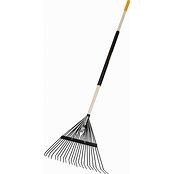
I was a steel rake kid: green, wooden handle, sturdy, union-made in a US factory.
Leaf blowers robbed the neighborhood of silence and raking the interior mind.
They corrupted our souls, bewitched us for convenience, seduced us to forsake rakes.
Do they still sell steel green rakes with wooden handles?
I hate plastic ones.
Too stiff, graceless.
The trilling sound made by a steel rake raking leaves, so distinct, soothing, a rhythm.
Massage therapists should play it during massages.
The novel The Virgin Suicides easily contains the best leaf raking scene in American literature (ch. 3, pp 86-89).
The author, Jeffrey Eugenides, compared the different methods that various suburban households raked their leaves: “The first weekend after leaf fall, we began raking in military ranks, heaping piles in the street.”
American families don’t rake leaves together anymore.